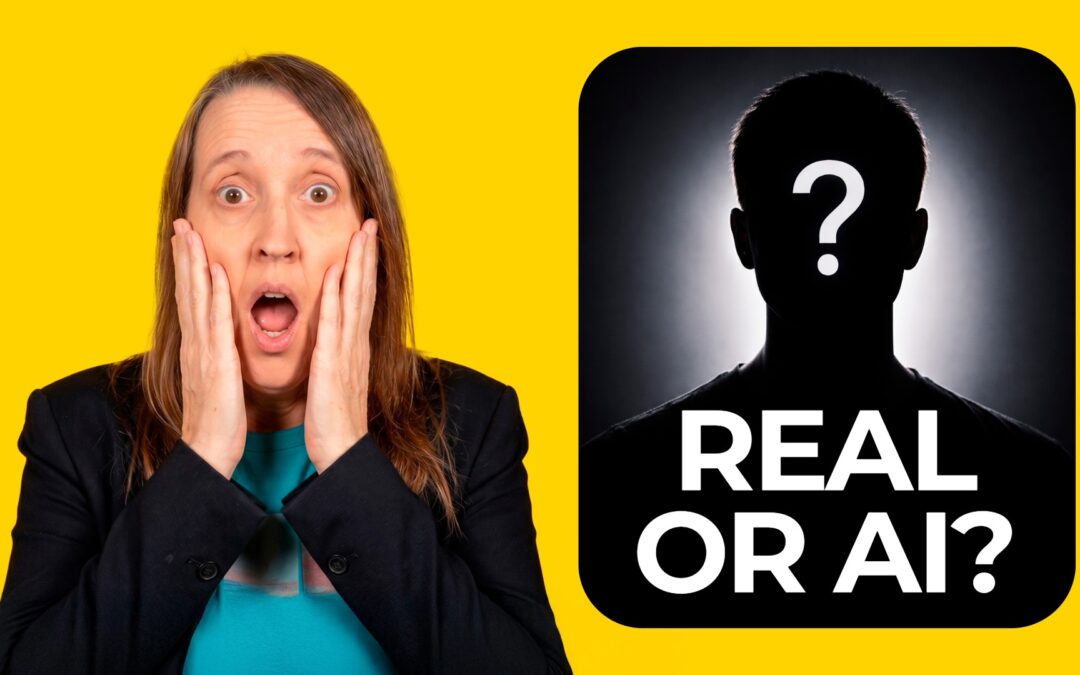
A friend of mine had been following a woman on Facebook. An elderly lady giving out health tips. She liked watching her videos. Then someone in the comments said: this is AI.
If you've ever wondered whether AI fake videos on Facebook could actually fool you or someone you care about, this is the story that might change how you look at your feed.
I Made a Fake AI Video in Ten Minutes
My friend sent me a screenshot of this "health guru" and I was curious. So I decided to show just how easy it actually is to create something like that.
I took the screenshot, uploaded it into an AI video tool, and within ten minutes I had the woman in the photo talking directly to my friend. Smiling, moving, speaking with what was supposed to be a Sicilian accent. Honestly, the accent wasn't totally convincing. But the video itself? Pretty realistic.
Ten minutes. That was it.
I'm sharing this because once you've seen how easy it is, you become more sceptical of what you see online. And that scepticism is worth having.
The Old Giveaways Are Disappearing
Until fairly recently you could spot an AI generated video if you looked closely enough. Weird hands. Things changing in the background. Subtle things, but noticeable. Those giveaways are disappearing fast. My friend recently shared a video with me that she was convinced was fake, and honestly, I thought it looked real.
Here's the other thing. The Facebook page my friend had been following had nearly a million followers. So follower count tells you nothing. Some of these fake AI accounts actually outperform real ones. A million followers and none of them knew they were watching a person who doesn't exist.
How to Spot AI Fake Videos and Scams on Social Media
So what can you actually do? The first thing is just to bring a little street-level scepticism to what you see online. If a stranger walked up to you in the street and offered you an unmissable health cure, you wouldn't hand over your bank details. The same logic applies when it shows up on your Facebook feed.
Beyond that, here are a few things worth checking:
Look at the comments. Is there genuine back and forth between the account holder and followers? Real conversations, not just generic replies. Though even that isn't foolproof these days.
Go directly to the source. If someone famous is promoting something, check their official website. Martin Lewis is a good example. There are loads of fake scam videos of him doing the rounds. If it's not on his own website, it's probably not real.
Use AI to check for you. Screenshot the thing, drop it into ChatGPT or Gemini, and ask: does this look like a scam? It's not perfect, but it catches a lot. I use this myself when something feels off but I can't quite put my finger on why.
You don't need to become a detective. You just need to pause a little before you believe something.
Why This Matters More Than You Think
I spent 25 years as a graphic designer, so I've always had an eye for when something looks "off" visually. But even I'm finding it harder to tell. The technology is moving that fast. I don't know about you, but I'd rather know what's possible and be a bit more cautious than get caught out by a smiling face that was generated by a computer.
If you've got friends or family who spend a lot of time on Facebook, it might be worth sharing this with them. Not to scare anyone, just so they know what ten minutes and a screenshot can do.
FAQ
Can AI really create a realistic fake video from just a photo?
Yes. Using current AI video tools, you can upload a single photo and generate a video of that person appearing to talk, smile, and move. It can be done in as little as ten minutes, and the results are increasingly hard to distinguish from real footage.
Does a large follower count mean a Facebook account is real?
No. Fake AI-generated accounts can attract hundreds of thousands, even millions, of followers. Follower count alone is not a reliable way to tell if an account is genuine.
What's the quickest way to check if a video might be an AI scam?
Take a screenshot of the video or post, upload it to ChatGPT or Google Gemini, and ask if it looks like a scam. It won't catch everything, but it's a quick and easy first check.
I share practical AI tips like this every week, aimed at over-50s who want to keep up without the jargon. If that sounds useful, you can sign up for my weekly AI emails and I'll see you there.